
Buying a Villa From Abroad? A 2026 Guide for NRIs Purchasing Property in Kerala

Buying a villa from abroad can feel challenging when you are not physically present for site visits or paperwork. If you want to buy a villa in Kerala from abroad, the good news is that Indian law fully supports it, and established developers now build remote friendly processes around exactly this situation. This guide walks you through legal eligibility, financing routes and the checks worth making before you commit funds from another country. You will also see how CMR Developers support NRI buyers with virtual tours, Power of Attorney arrangements and staged payments, so the process stays manageable across time zones, whether you are based in the Gulf, the UK, the US, Australia or elsewhere.
Key Takeaways
- NRIs can legally purchase residential property, including villas, in Kerala without special RBI approval, except for agricultural or plantation land.
- Remote buying works best with virtual site visits, a trusted Power of Attorney holder and payments linked to construction milestones.
- NRI home loans in Kerala usually run through NRE or NRO accounts, each suited to a different source of funds.
Can NRIs Legally Buy a Villa in Kerala?
Yes. Under the Foreign Exchange Management Act, an NRI who holds Indian citizenship can purchase any residential or commercial property in India, including a villa in Kerala, without seeking prior approval from the Reserve Bank of India. The only exclusions are agricultural land, plantation property and farmhouses. The Reserve Bank has repeatedly clarified this position for both NRIs and Overseas Citizens of India, removing a common source of confusion among first time overseas buyers.
That said, legal eligibility is only the starting point. Buyers still need valid documentation, including a PAN card, a valid passport and proof of NRI status, along with the usual property paperwork such as title deeds, encumbrance certificates and approved building plans. If you hold OCI or PIO status rather than an Indian passport, the same broad purchase rights generally apply, though it remains worth confirming your specific category with a legal advisor. Reviewing the Reserve Bank’s official FEMA guidelines before you begin gives you a reliable reference point, separate from anything a developer or agent tells you. Because rules can be updated, always confirm current requirements with a qualified legal advisor before transferring any funds.
Working with a developer that understands NRI documentation, such as CMR Developers, established in 2012, which has guided overseas buyers through this process as part of its wider NRI investment support, can reduce friction considerably. Support of this kind typically extends to explaining NRE and FCNR account requirements for routing your payments correctly from the outset.
Why Kerala Villas Attract NRI Real Estate Investment
Kerala holds a unique pull for NRIs that goes beyond financial return. Many overseas buyers grew up in the state or have close family still living there, and a villa represents a tangible connection to that background, not just an asset on a balance sheet. This emotional pull, combined with steady infrastructure upgrades across the state, explains much of the current interest in Kerala property for NRIs.
Gated villa communities add a practical layer to that appeal. Buyers get landscaped surroundings, boundary security and shared amenities without having to manage them individually, which matters when the owner lives thousands of miles away. Developers with a long track record, including CMR Developers, established in 2012 with more than fourteen years of villa development experience across Kannur, Ernakulam and Kottayam, are often better positioned to deliver that kind of managed community living.
Improving road links, airport connectivity and civic infrastructure across these districts have also made day to day life easier for residents and, by extension, more appealing for buyers planning an eventual return to Kerala. Many overseas buyers additionally look for Vastu compliant layouts, which some Kerala developers now offer as part of custom villa planning for families who value this in their new home.
It is worth noting that property values, rental demand and appreciation vary by location and project, so general trends about Kerala real estate should never be treated as a guarantee for any specific villa. Buyers should always verify project specific details, including pricing and possession timelines, directly against the current listing before deciding.
Villas for NRI Buyers: What to Check Before You Buy From Abroad
Due diligence matters even more when you cannot walk the site yourself. Start by confirming the project’s registration on Kerala’s RERA portal, which lists approved projects, promoter details and declared timelines in one place. A registered project is not a guarantee of investment performance, but it does confirm that basic disclosure requirements have been met.
Next, ask for a virtual site tour. Reputable developers now offer live video walkthroughs of both the site and any completed sample villas, which lets you assess construction quality and surrounding infrastructure without booking a flight. Pair this with photo and video updates during construction, so you can track progress stage by stage rather than waiting for a single handover update.
Most NRI buyers also rely on a Power of Attorney to sign documents and manage formalities in India, since travelling for every step is rarely practical. Choose this person carefully, keep the POA scope specific to the transaction, and have it notarised and attested correctly for use in India. Combine this with a stage linked payment schedule tied to construction milestones, which limits how much capital is exposed at any one point.
Finally, ask whether construction is handled by an in house construction team, since this affects accountability if issues arise later. Developers who keep engineers, masons and finishing specialists on their own payroll, rather than outsourcing the build, tend to offer more consistent quality control across a project. A developer’s overall delivery history, such as the more than 600 villas CMR Developers states it has delivered since 2012, can be a useful data point, though it should still be weighed alongside project specific reviews and documentation rather than taken as a standalone assurance.
NRI Home Loan Kerala: Understanding Your Financing Options
Financing a villa from abroad usually runs through one of two account types. An NRE account holds foreign earnings that have been remitted to India, and both the principal and interest are tax free and fully repatriable, which makes it a common choice for funding a down payment from overseas savings. An NRO account, by contrast, holds income earned within India, such as rent from an existing property, and interest on it is taxable, with repatriation subject to annual limits.
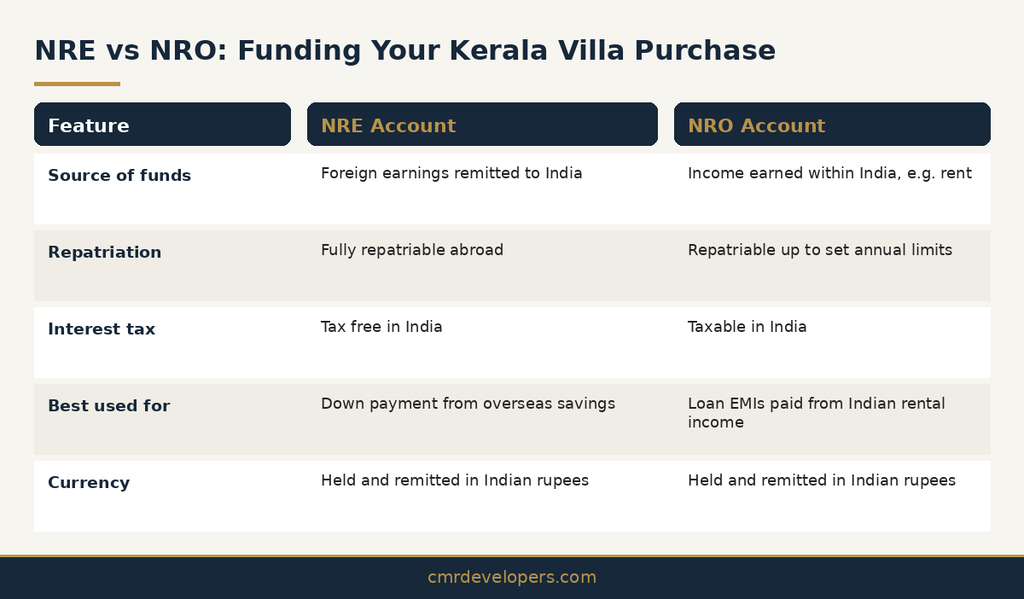
Most Indian banks offer NRI home loan Kerala products that allow repayment through either account, though many buyers prefer linking EMIs to an NRO account funded by Indian rental income once the villa is completed and tenanted. Lenders will assess income documentation, employment stability abroad and existing liabilities before sanctioning any loan, and approval is never guaranteed for every applicant, regardless of what a broker or developer may suggest. It is worth comparing offers from more than one bank, since interest rates, processing fees and the loan to value ratio can vary meaningfully between lenders.
If you plan to use financing, start the loan conversation early, ideally before you finalise a villa, so you understand your realistic budget and avoid delays once you are ready to sign. Keep in mind that not every applicant will qualify for the amount they hope for, so having a clear backup plan for the down payment portion, drawn from your own NRE savings, gives you more negotiating room with the developer.
Managing Property in Kerala as an NRI After Purchase
Ownership does not end at handover. Managing property in Kerala as an NRI usually means appointing someone locally, whether a family member, a property manager or the developer’s post sale service team, to handle routine matters like utility payments, maintenance requests and periodic inspections.
If you plan to rent the villa out, factor in that rental income is taxable in India and should be routed through an NRO account, with returns filed accordingly. Keep property tax payments current, retain digital copies of every document, and revisit your Power of Attorney periodically to confirm it still reflects your needs, especially if your circumstances or the person you nominated change over time.
For villas inside a managed community, community association fees and shared maintenance charges typically continue after possession, so budgeting for these ongoing costs alongside any loan EMI gives a more realistic picture of long term ownership. Repatriating sale proceeds later, should you ever decide to sell, is also governed by FEMA limits and documentation, so keeping organised records from day one makes that future process considerably smoother.
Final Thoughts
Buying a villa in Kerala from abroad is entirely achievable once you understand the legal framework, financing routes and the extra checks that distance requires. Confirm eligibility, verify every project independently, choose financing that matches your income sources, and put a reliable local point of contact in place before and after handover. With the right preparation, an nri real estate investment guide like this one becomes less about managing uncertainty and more about making an informed choice from wherever you live. If you are ready to explore current villa options, reach out to a developer with established NRI support to start the conversation.
FAQ
Q1. Can NRIs buy a villa in Kerala from abroad without visiting in person?
Yes. NRIs can buy a villa in Kerala from abroad using virtual site tours, video walkthroughs and a Power of Attorney for signing. Physical presence helps but is not legally required, since developers increasingly support fully remote purchase processes.
Q2. Do NRIs need RBI permission to purchase a villa in India?
No. NRIs holding Indian citizenship do not need prior RBI approval to purchase residential property, including villas, under current FEMA rules. The main exceptions are agricultural land, plantation property and farmhouses, which remain restricted for all NRI buyers.
Q3. What documents does an NRI need to buy a villa in Kerala?
Typical requirements include a valid passport, PAN card, proof of NRI or OCI status, and standard property documents such as the sale agreement, title deed and encumbrance certificate. Requirements vary, so confirm the current checklist with your developer and lawyer.
Q4. Is an NRI home loan in Kerala hard to get approved?
Approval depends on income documentation, employment stability and existing liabilities, and it is never guaranteed for every applicant. Comparing NRI home loan Kerala offers from multiple banks, and keeping paperwork organised in advance, generally improves your chances of approval.
Q5. Should NRIs use an NRE or NRO account for villa payments?
Many buyers use NRE funds, sourced from foreign earnings, for the down payment, since it is fully repatriable and tax free. NRO accounts, holding Indian sourced income such as rent, often handle ongoing loan EMIs once the villa is tenanted.
Q6. How should NRIs approach managing property in Kerala as an NRI after buying it?
Most owners appoint a family member, property manager or the developer’s after sales team to oversee maintenance, utility payments and inspections. Managing property in Kerala as an NRI from a distance works best with clear instructions and periodic updates.
Q7. Can NRIs rent out their Kerala villa and repatriate the income?
Yes, though rental income is taxable in India and should be routed through an NRO account. Repatriation of that income, and later of sale proceeds, follows FEMA limits and documentation requirements, so organised records from the start help considerably.
Q8. Are gated villa communities in Kerala a good fit for NRI families?
Many NRIs prefer gated communities for the added security, shared amenities and lower day to day maintenance burden while living abroad. Buyers can browse current villa projects to compare layouts and locations before deciding which community suits them.
Q9. What is the biggest risk when buying a villa in Kerala from abroad?
The main risk is relying on verbal assurances instead of verified documents. Always confirm title clarity and current project status yourself, ideally through the developer’s official project listings, rather than assuming every general claim applies to every villa.